Japanese Gardens | Japan Travel Guide
The Japanese Garden represents many aspects of the Japanese culture. Zen and serenity calm your soul as you stroll down the paved paths past the koi pond and bamboo to a place of peace. These Japanese gardens in Japan served various purposes, whether it be part of the residence of a shogun or a recreational park for the public to enjoy. Whatever its purpose was in the past, the most renowned Japanese gardens were not available for the local people to enjoy and appreciate. Now, it's become more accessible to walk along the garden grounds in Japan.Enjoy the serene sounds of nature while navigating the beautiful rock gardens, koi fish ponds, and small shrines. A stroll through a Japanese garden might be exactly what you need to find peace or relax during your stay in Japan.
Garden Components
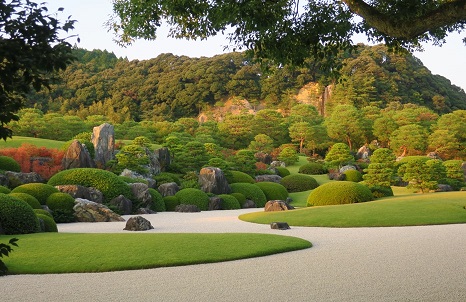
The Japanese garden is mainly composed of a centrally located pond, an artificial hill with a slope, and various combinations of stones in order to reproduce the natural landscape.The composition of the garden varied from time to time. Below are the main components;
Water:
To reproduce the Japanese natural scenery, water is a very important element. It changes its appearance in various ways, such as springs, water flows along the terrain (Yarimizu), and a pong creating a serene environment.
Mountains:
A mountain artificially created in a Japanese garden is called "Tsukiyama". The gentle slope which stands for the landscape of the field is called "Nosuji".
Ishigumi - Stone Arrangements:
At first glance, the huge rocks that seem to be arranged randomly are actually placed there with various rules and intentions. "Shichigosan stone arrangement", as an example, is the one of the famous ishigumi and stones are placed in seven, five, and three groups. It is considered as a good omen.
Plants:
A variety of seasonal plants such as pines, maples, willows, plums, cherries, azaleas and roses are used.
Buildings:
Not only the temple hall, but also the spring in the pond, the pier, and the bridge over the pond are important elements that make up the Japanese garden.
Pebbles, Stepping Stones, Paving Stones:
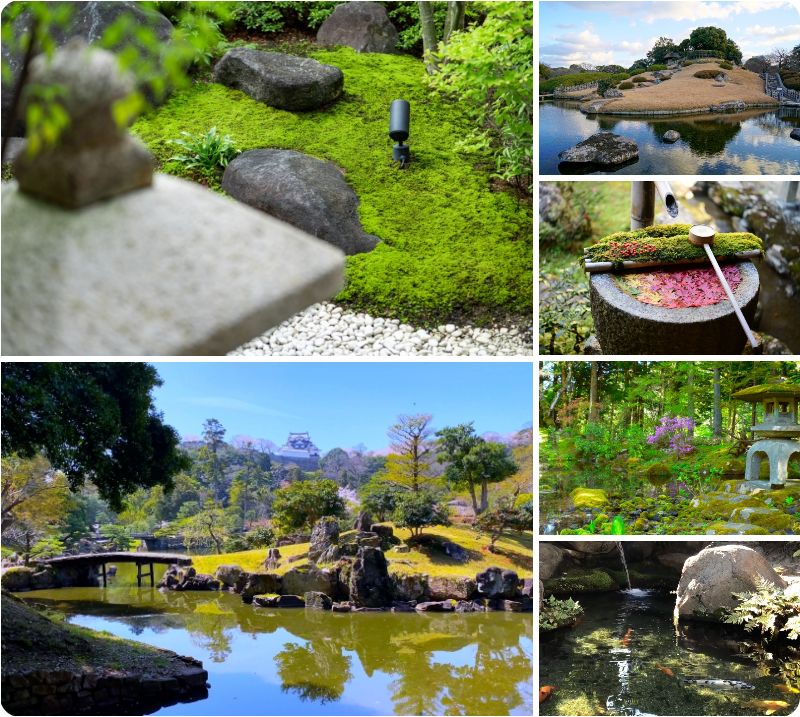
Stepping stones and paving stones are placed buried in gravel and moss to indicate the way people walk.
Stone Lantern:
Originally it was started by Sennorikyu. It is said that he saw the embers of the stone lantern at dawn, felt the beauty of Wabi-Sabi and incorporated it into the garden.
Chozubachi (washbasin), Shishi-odoshi:
A chozubachi is placed to wash hands. Shishi-odoshi, the water-filled bamboo tube which clacks against a stone when emptied was made to enjoy the sound.
Bamboo Fence:
It is used as a partition of the space.
Japan's Three Great Gardens
Kenrokuen garden in Kanazawa (Ishikawa prefecture), Korakuen garden in Okayama (Okayama prefecture), and Kairakuen garden in Mito (Ibaraki prefcture) are considered as "Three Great Garden in Japan".These three major gardens have common characteristics. Needless to say, these gardens are suplendid as a garden, but are strolling gardens built by daimyo during the Edo period. It is a style that you can enjoy waliking around the garden.