Japanese Shrine | Japan Travel Guide
In Japan, each area, such as villages and towns, has its own shrine. The god of each area is called Ujigami-sama, the protecting god, and people who believe in this god are called uji-ko, or protected children.
The Japanese people have many traditions for every season and for important times in a person's life. Most of them have something to do with the Ujigami-sama god. Speaking of traditions for every season, they begin with hatsu-mode, followed by the haru-matsuri, where people pray for good crops, and the aki-matsuri, where people thank the gods for good crops.
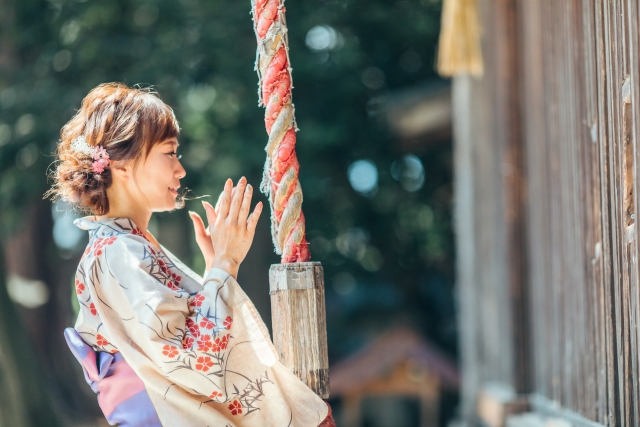
Life Event
In addition, traditions for important times in a person's life include miya-mairi, which is held for 30-day-old babies, shichi-go-san, which is the celebrations for 7,5,3 years old, and so on. Apart from these traditions, people with bad luck sometimes visit a shrine to get purified.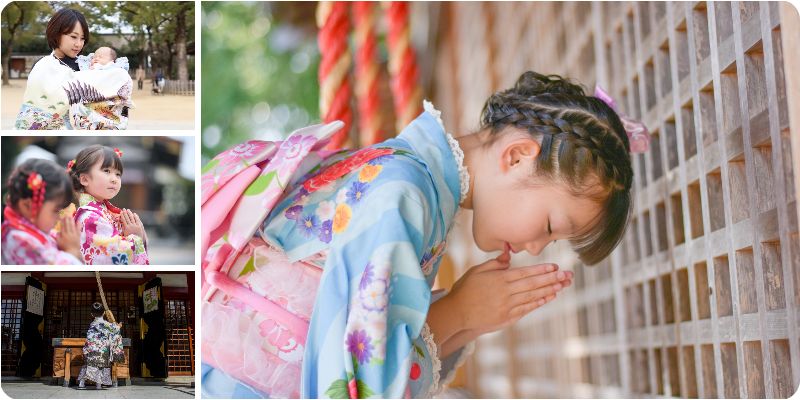
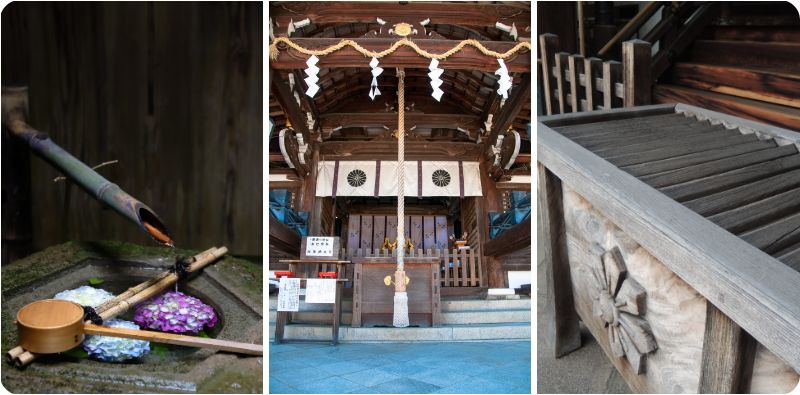
Traditional Rules
There are some traditional rules when people visit a shrine. People must wash their hands before they pray. They stand before the alter, bow once, and ring a bell. Next, they throw and offer of money, usually coins, into a box and take two deep bows. Then, they join their hands together and clap twice. Finally, they pray to the god and bow deeply once more. This is called ni-hai-ni-hakushu-ichi-hai, two bows, two claps and one bow.
Poeple and Article
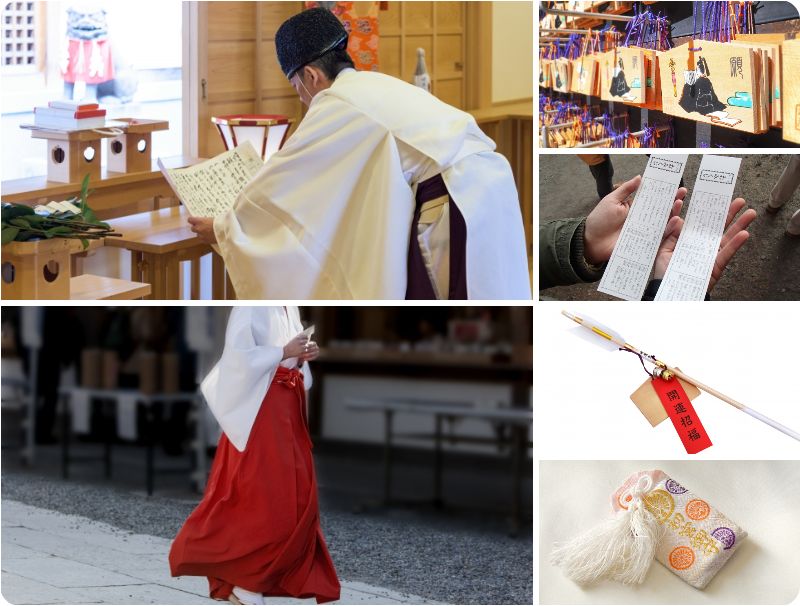
People who serve at a shrine
Kannushi --- The chief Shinto priest who performs the rituals at a shrine.
Miko --- Unmarried woman in the service of duties.
Small article in a shrine
Ema --- Avotive offering board with a horse drawing, dedicated to the deities. Used for expressing prayers or acknowledging when a wish has been fulfilled.
Omikuji --- An oracle drawn to determine one's fortune. When the person choose a stick, he/she is given a paper on which the corresponding fortune is written.
Omamori --- A paper charm of a god or Buddha used for protection or making a wish.
Hamaya --- Arrows given by shrines to visitors on New Year's day, wishing them good luck.
Reference: Japan at a Glance Updated